Hello there, economists! Today I present you a little powerpoint presentation I made for you to understand the employment topic a little bit better. Check it out here :
Today`s topic: Profit!
Hello there, economists! Since we all love money, I thought today I should talk about /profit/ , since it’s the main factor to making money. Here I included a short and fun brochure explaining roughly the meaning of profit : https://pubsecure.lucidpress.com/a0c24cf1-87c6-46e5-8af0-138252494170/ . Enjoy!
And also, here it is the PDF file for anyone interested!
Want to know about market failures? Check this out!
Hello there, economists! For you to understand the topic of market failures better, I’ve made a prezi presentation explaining everything you need to know. Here you go: https://prezi.com/view/jKOZrjiVCABM9PrghejS/ , and have fun researching!
Competition under various market structures.
Market structures
There are several market structures in which firms can operate. The type of structure influences the firm’s behaviour, whether it is efficient, and the level of profits it can generate.
Neo-classical theory of the firm distinguishes a number of market structures, each with its own characteristics and assumptions.
The structure of a market refers to the number of firms in the market, their market shares, and other features which affect the level of competition in the market.
Market structures are distinguished mainly by the level of competition that exists between the firms operating in the market.
Competitive structure vs competitive behaviour
As well as considering market structures, modern theory also looks at the behaviour, or conduct of firms, their performance, and the level of contestability in the market.
A market might have an uncompetitive structure, with only a small number of firms competing, but the behaviour of firms might be highly competitive, as is the case in the UK with the supermarket sector.
Market structures
Structures are classified in term of the presence or absence of competition. When competition is absent, the market is said to be concentrated. There is a spectrum, from perfect competition to pure monopoly.

Price elasticity of demand.
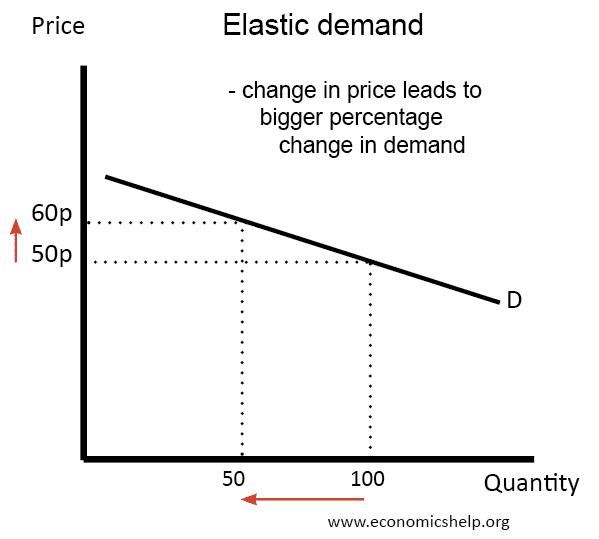
Price elasticity of demand (PED or Ed) is a measure used in economics to show the responsiveness, or elasticity, of the quantity demanded of a good or service to increase in its price when nothing but the price changes. More precisely, it gives the percentage change in quantity demanded in response to a one percent change in price.
Price elasticities are almost always negative, although analysts tend to ignore the sign even though this can lead to ambiguity. Only goods which do not conform to the law of demand, such as Veblen and Giffen goods, have a positive PED. In general, the demand for a good is said to be inelastic (or relatively inelastic) when the PED is less than one (in absolute value): that is, changes in price have a relatively small effect on the quantity of the good demanded. The demand for a good is said to be elastic (or relatively elastic) when its PED is greater than one.
Revenue is maximised when price is set so that the PED is exactly one. The PED of a good can also be used to predict the incidence (or “burden”) of a tax on that good. Various research methods are used to determine price elasticity, including test markets, analysis of historical sales data and conjoint analysis. Price elasticity of demand further divided into Perfectly Elastic Demand (∞) Perfectly Inelastic Demand ( 0 ) Relatively Elastic Demand (> 1) Relatively Inelastic Demand (< 1) Unitary Elasticity Demand (= 1).
 All things economy